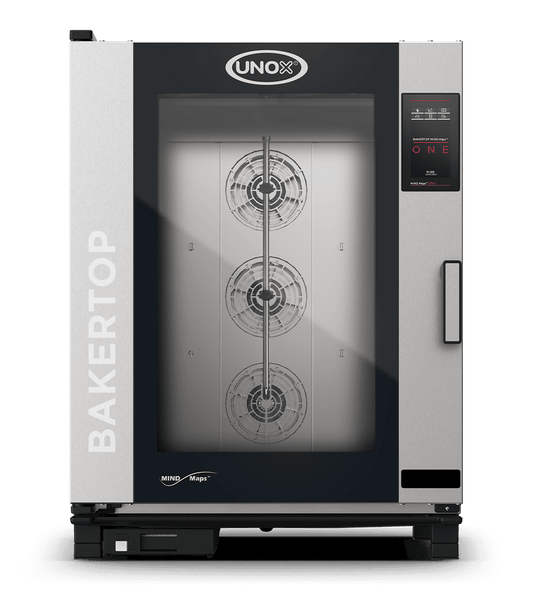
One oven that roasts, bakes and steams changes the arithmetic of a kitchen — pastries at seven, joints at noon, banquet trays by eight, in less space than separate appliances would claim. The choice comes down to five decisions, and the first one is not the brand.
What the steam actually buys you
A convection oven moves hot air; a combi adds controlled humidity. Steam is what stops roasts drying out, holds weight on cooked meat, gives bread its crust and lets you regenerate plated food without ruining it. If your menu is mostly baking and dry roasting, a convection oven with a humidity function may be all you need. If you are cooking proteins to a standard every service, the combi pays for itself in yield.
Size by GN capacity, not by footprint
Ovens here are specified in Gastronorm trays: from 3× GN 1/1 countertop models up to 20× GN 2/1 floor-standing machines, with 5, 6, 7, 10 and 12-tray sizes in between. The useful question is how many covers leave the pass in the busiest hour, then add a tray for the thing you forgot. Undersizing shows up as a queue at the oven door; oversizing shows up on the electricity bill. Match your trays to the gastronorm containers already in the kitchen.
Gas or electric
Electric ovens are simpler to install, easier to control precisely, and increasingly the default where three-phase power is available — the models here run from around 5 kW on a countertop unit to 60 kW on a 20-tray machine, so check the supply before you fall in love with a spec. Gas ovens still make sense where power is limited or gas is materially cheaper. Both appear across the range from makers like Unox and Smeg.
Manual controls or programmable
Manual dials are fast to learn, cheap to maintain and hard to break — the right call for a small brigade cooking a stable menu. Programmable ovens store recipes, run multi-stage cooking unattended and hold consistency across shifts and staff turnover. If the same dish has to leave the pass identically whoever is on, programmable is not a luxury.
Countertop, floor-standing or trolley
Countertop models sit on a stand or above a prep bench and suit cafés, small kitchens and satellite units. Floor-standing machines carry the main service. Trolley versions — 16 trays and up — are for bakery and banqueting, where you roll a loaded rack straight in. Whichever format, plan the extraction at the same time: see ventilation, and the wider ovens and bakery range for deck and bakery formats.