Kylskåp för utställning
I en butik eller delikatessaffär är skyltfönstret din mest effektiva säljare: kunderna köper det som ser färskast ut, och med rätt skyltfönster ser varorna fräscha ut hela dagen. Sortimentet – där bland annat Tecfrigo ingår – omfattar bakverksskåp, delikatessdiskar och butiksskyltfönster. Komplettera med kylutrymmen från det bredare kylsortimentet.
Kategorier
Kategorier
-

Tefcold Steel-Lid Vitrine Cooler GVC38-180 S/S, 56,8 l
Ordinarie pris 533,48€Ordinarie prisFörsäljningspris 533,48€ -
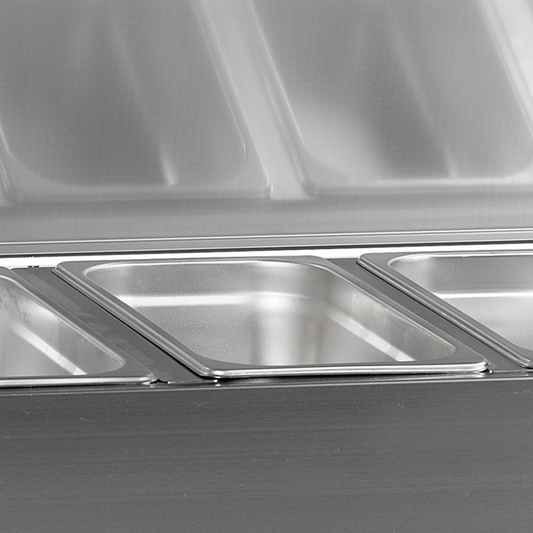
Tefcold Steel-Lid Vitrine Cooler GVC38-120 S/S, 28,4 l
Ordinarie pris 475,07€Ordinarie prisFörsäljningspris 475,07€ -

Tefcold Steel-Lid Vitrine Cooler GVC38-200 S/S, 63,9 l
Ordinarie pris 554,90€Ordinarie prisFörsäljningspris 554,90€ -

Tefcold Steel-Lid Vitrine Cooler GVC38-150 S/S, 42,6 l
Ordinarie pris 501,35€Ordinarie prisFörsäljningspris 501,35€ -

Tefcold Steel-Lid Vitrine Cooler GVC33-180 S/S, 41,6 l
Ordinarie pris 501,35€Ordinarie prisFörsäljningspris 501,35€ -

Tefcold kylvitrin GVC38-180, 56,8 l, +2/+8 °C
Ordinarie pris 533,48€Ordinarie prisFörsäljningspris 533,48€ -

Tefcold Steel-Lid Vitrine Cooler GVC33-160 S/S, 1600 mm bred, 36,4 l
Ordinarie pris 485,78€Ordinarie prisFörsäljningspris 485,78€ -

Tefcold Steel-Lid Vitrine Cooler GVC33-200 S/S, 52 liter, +2/+8 °C
Ordinarie pris 522,77€Ordinarie prisFörsäljningspris 522,77€ -

Tefcold kylvitrin GVC33-140, 31 liter, +2/+8 °C
Ordinarie pris 467,28€Ordinarie prisFörsäljningspris 467,28€ -

Tefcold kylvitrin GVC33-200, 52 l, +2/+8 °C
Ordinarie pris 522,77€Ordinarie prisFörsäljningspris 522,77€ -

Tefcold Steel-Lid Vitrine Cooler GVC38-160 S/S, 49,7 l
Ordinarie pris 519,85€Ordinarie prisFörsäljningspris 519,85€ -

Tefcold kylvitrin GVC38-160, 49,7 l, +2/+8 °C
Ordinarie pris 519,85€Ordinarie prisFörsäljningspris 519,85€
Begär en projektspecifik konsultation
Lämna dina kontaktuppgifter så ringer vi upp dig.
Relaterade samlingar
-
Kylutrustning för livsmedelsbutiker
I en livsmedelsbutik är kylsystemet själva försäljningsytan – när ett kylskåp slutar...
-
Kommersiell kylteknik
Kyl- och frysutrustning är det enda system som ett kök inte kan...
-
Hot display cases
Hot food only sells while it looks and stays hot — a...
-
Display cases & Showcases
The right showcase does the selling before anyone says a word: merchandise...
Buying guide
How to choose a refrigerated display case
A display case is the hardest-working salesperson in the room. Customers buy what looks freshest, and the case decides whether it does. The specification follows the buying moment, not the product.
Match the case to how people buy
Serve-over counters put staff between customer and product — right for delis, butchery, fish and anything sold by weight. Self-service cases let customers lift the product themselves, which lifts basket size and suits grab-and-go, drinks and packaged chilled lines. Impulse formats — countertop cases and island freezers — go where the queue forms, not where there is space on the wall. Most shops need two of the three.
Chilled or frozen, and how cold
Chilled display runs above zero and covers pastry, deli, drinks and fresh counters. Frozen display runs cold enough to hold ice cream hard — the upright display freezers here work around −24 to −16 °C, which is the band that keeps product properly frozen rather than merely cold. Ice cream and gelato have their own requirements again: see ice cream and gelato freezers.
Size by linear metre, buy by litre
Retail plans in metres of run; the equipment is sold in litres of usable volume. Both matter. The range here spans compact bottle coolers of a couple of hundred litres up to island and combination freezers past 900 litres and beyond two metres of run. Work out the metres your layout allows first, then check that the litres behind them match how often you restock.
Glass doors or open front
Open multi-decks sell harder — nothing between hand and product — and cost materially more to run. Glass-door merchandisers cut energy use substantially and hold temperature better in a warm shop, at the price of one extra action from the customer. The honest rule: open fronts for high-turnover impulse lines, glass-door merchandisers for everything that sits.
Where the heat goes
Integral units are self-contained: plug in, switch on, and the waste heat and compressor noise stay in the room. Remote units send the condensing side outside or to a plant room — quieter, cooler on the shop floor, and standard once you are running several cases. Above a handful of units, remote is usually the cheaper answer over the life of the shop. For a full-store plan, start at supermarket refrigeration.